Another example of digital art (see previous post on postsecret) that is shaping the boundaries of a new self is found at the 'largest art community in the world' in www.deviantart.com. The purpose is that users within the 'deviant' community post their works, mostly photography or digital manipulation to a community of fellow 'artists'. What I can most strikingly see as different in this type of artistic expression, is how it is made for and by the community. For the community since the works are mostly posted in view of obtaining comments and recognition from others. By the community, since the most viewed works are displayed first, easier to find, and thus subject to the community's approval.
At the same time, within this community, one can organize and keep a list of favourite artists and works, thus defining one's place in the web of 'digital online artists'.
Thursday, 8 March 2007

Tuesday, 6 March 2007
Blog - Acknowledging the medium, but also its web of relations
I've talked about how hypermediacy confronts us with the medium, by acknowledging and addressing it. This was a trend that surfaced more clearly in modern art, in paintings as discussed in my previous post, but also in other forms of expression, such as in Dziga Vertov's movie 'Man with a movie camera'.
In the new digital media, it is not only the medium that surfaces and is brought to light, but the whole web of relations that makes the medium and the content possible. The piece of art within digital media is not an isolated piece that can be exhibited in a fictional museum of 'digital art', but is formed by the pre-existing content in an explicit way.
This could be compared to 'filmic quotes', where movies make allusions to older ones, such as when the film 'Metropolis' from 1927 quotes parts of the movie 'Cabiria' from 1914, making an analogy between the industrial mega-machine with the 'temple of Moloch'. However, the movie is still a 'stand-alone' piece, while digital art, specifically within the context of digital communication networks, only exists within the network. That is, if we forget that the movie also depends on a network to exist. The film only exists with projectors and spaces designed for its projection, which a Latourian conceptualization of actor-networks helps to illuminate.
I maintain, despite this, that hypermediacy goes one step further in digital expression media such as blogs. That is, because the external influences and references are explictly part of the content of a blog, not only implicitly as in the case of movies. The content is in part formed by windows to spatially and temporally distinct elements.
In the new digital media, it is not only the medium that surfaces and is brought to light, but the whole web of relations that makes the medium and the content possible. The piece of art within digital media is not an isolated piece that can be exhibited in a fictional museum of 'digital art', but is formed by the pre-existing content in an explicit way.
This could be compared to 'filmic quotes', where movies make allusions to older ones, such as when the film 'Metropolis' from 1927 quotes parts of the movie 'Cabiria' from 1914, making an analogy between the industrial mega-machine with the 'temple of Moloch'. However, the movie is still a 'stand-alone' piece, while digital art, specifically within the context of digital communication networks, only exists within the network. That is, if we forget that the movie also depends on a network to exist. The film only exists with projectors and spaces designed for its projection, which a Latourian conceptualization of actor-networks helps to illuminate.
I maintain, despite this, that hypermediacy goes one step further in digital expression media such as blogs. That is, because the external influences and references are explictly part of the content of a blog, not only implicitly as in the case of movies. The content is in part formed by windows to spatially and temporally distinct elements.
The blog as digital collage
Digital media, or hypermedia, confronts us with the possibility to create a montage of different media elements together, such as text, graphics, animations, sounds, or videos. The process of collage is taken one step further, where the elements put together have different natures. The digital environment is hypermediated in the sense that it multiplies and re-arranges media forms.
Furthermore, in blogs, the elements that are put together are many times shared by other internet users. A picture appearing in this blog may be taken from another blog, or website, and particular pieces of text may provide 'windows' to jump to other spaces within the Network. This process of 'collage' combines both 'thick' self-created digital content with 'thin' direct references to pre-existing content. The result of expressing oneself in this medium is that the expression is constituted by links to other people's expressions.
In this blog, I use the software for generating blogs from blogger.com, and the images used are taken from other sources in the Net. At the same time, as part of my discourse, I provide links to other places around the network. The blog fully acknowledges not only the medium, but the relationships implicated by the medium. The blog does not exist alone, but only with respect to the wider Web. When I express myself in this medium, I gather different sources that constitute and make the finalized piece possible. The collage uses different types of media from different sources, or locations.
Furthermore, in blogs, the elements that are put together are many times shared by other internet users. A picture appearing in this blog may be taken from another blog, or website, and particular pieces of text may provide 'windows' to jump to other spaces within the Network. This process of 'collage' combines both 'thick' self-created digital content with 'thin' direct references to pre-existing content. The result of expressing oneself in this medium is that the expression is constituted by links to other people's expressions.
In this blog, I use the software for generating blogs from blogger.com, and the images used are taken from other sources in the Net. At the same time, as part of my discourse, I provide links to other places around the network. The blog fully acknowledges not only the medium, but the relationships implicated by the medium. The blog does not exist alone, but only with respect to the wider Web. When I express myself in this medium, I gather different sources that constitute and make the finalized piece possible. The collage uses different types of media from different sources, or locations.
Monday, 5 March 2007
Remediating the self
Blogging also serves as a way for self-expression. In different types of media, the expression of the self is achieved in different ways, which means that the media itself contributes to how the self is constituted within it. Through media, we are able to define our personal and cultural identity, which serves as our 'anchor' to a given period of history. The fact that our identity is transported through different types of media, means it is subject to a process of 'remediation', where references to older types of media and new possibilities offered by new media converge in the fabrication of the expression of a contemporary self.
In one sense, personal blogs are 'remediations' of the old personal journals, put into the context of digital media. At the same time, the new digital media and communication technologies open up new possibilities for expressing the 'self', which were previously inexistent - this is best captured through the notion of a 'networked self'. In the digital media, which the blogs are part of, the self is constituted by the hypercontextualization within a widespread practice of information exchange. The self in the digital era needs to be defined in relation to the web-like structure of our current lives, where every action and piece of information at a 'node' is connected and defined by the links to it.
When writing a journal, the constructed self is one living a secret and rich life, where the most intimate thoughts are expressed only to oneself. In digital media, the constructed self is a networked self, which is constantly linked and engaged with other selves. We cannot afford individuality in the new 'digital media' and the constructions of selves reflect the highly web-like structure of our lives. At the same time, the blog recenters the subject, since it defines its place in a web of relations. Thoughts are expressed in the blog within this context, and not to a single personal addressee. I will develop this in further posts!
In one sense, personal blogs are 'remediations' of the old personal journals, put into the context of digital media. At the same time, the new digital media and communication technologies open up new possibilities for expressing the 'self', which were previously inexistent - this is best captured through the notion of a 'networked self'. In the digital media, which the blogs are part of, the self is constituted by the hypercontextualization within a widespread practice of information exchange. The self in the digital era needs to be defined in relation to the web-like structure of our current lives, where every action and piece of information at a 'node' is connected and defined by the links to it.
When writing a journal, the constructed self is one living a secret and rich life, where the most intimate thoughts are expressed only to oneself. In digital media, the constructed self is a networked self, which is constantly linked and engaged with other selves. We cannot afford individuality in the new 'digital media' and the constructions of selves reflect the highly web-like structure of our lives. At the same time, the blog recenters the subject, since it defines its place in a web of relations. Thoughts are expressed in the blog within this context, and not to a single personal addressee. I will develop this in further posts!
Sunday, 18 February 2007
Media (hypermediacy, immediacy)
 Velazquez Las Meninas
 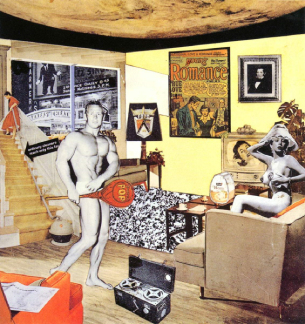 (Richard Hamilton Just What Is It That Makes Today's Homes So Different, So Appealing?)
 I want to show the following images, the first dated from 1656, by Diego Velazquez, and the second from 1956 by the collage artist Richard Hamilton.
The reason I'm showing these images, is to illustrate a particular way in which we use media for artistic self-expression. The two paintings are from very different periods. What they share in common, is an explicit acknowledgement of the media. In Velazquez period, media was usually withdrawn from the process of representation. It was merely a vehicle for achieving immediacy, which is the presence of the represented object(s) in face of the viewer. Of course, this desire for immediacy was never complete, since the complete 'erasure' of the media is impossible.
As a reaction to this, artists started to express themselves not only through the media as carrier of representations to an 'external' world, but through the media itself, as the collage work by Hamilton demonstrates. Contemporary art is marked by the fascination with media, and has moved away from the classic representations of scenes (real or imagined) closer to direct expression through manipulation of the media. This is framed by the concept of hypermediacy. In Velazquez' painting which I show above, hypermediacy is present in the awareness of the process of mediation. Velazquez paints himself in the process of painting the Spanish royal couple, which appear in the mirror, while their daughter stands in the center of the image next to the artist. In the later work of Hamilton, the act of mediation is at the center of the art work, in a more radical way, with its collage of different elements - many of which refer to media items in a culture obsessed with it.
Saturday, 17 February 2007
Postsecret blog
Now I want to talk about a specific type of 'thick' blog, which motivated my interest as a nice example of remediated art.
The 'Postsecret' blog http://postsecret.blogspot.com/ is self-described as an 'ongoing community art project where people mail in their secrets anonymously on one side of a homemade postcard'. The experience translates real 'hard' media, that goes through postal service, computer digitalization, and ends in a digital weblog-style timeline among a multitude of secrets posted by other people. The blog keeper is only doing the task of 'remediating' (more on this concept soon) the received letters into the blog. The experience is one of sharing secret feelings anonymously with a wide audience, which may bring comfort to those who post them by the act of sharing itself, and possibly by receiving support from others in the form of feedback on the blog, and may also bring comfort to people who share the same feelings being exposed on the blog.
 A fast skip through this blog revealed many touching, sincere thoughts, that brought me a heart-warming experience in an otherwise 'sterile' and isolated setting such as the one I am in right now - alone, sitting in front of the laptop screen.
The 'Postsecret' blog http://postsecret.blogspot.com/ is self-described as an 'ongoing community art project where people mail in their secrets anonymously on one side of a homemade postcard'. The experience translates real 'hard' media, that goes through postal service, computer digitalization, and ends in a digital weblog-style timeline among a multitude of secrets posted by other people. The blog keeper is only doing the task of 'remediating' (more on this concept soon) the received letters into the blog. The experience is one of sharing secret feelings anonymously with a wide audience, which may bring comfort to those who post them by the act of sharing itself, and possibly by receiving support from others in the form of feedback on the blog, and may also bring comfort to people who share the same feelings being exposed on the blog.
 A fast skip through this blog revealed many touching, sincere thoughts, that brought me a heart-warming experience in an otherwise 'sterile' and isolated setting such as the one I am in right now - alone, sitting in front of the laptop screen.
thin and THICK blogs
I want to address and try to categorize the content of blogs. Blogs generate content at different levels. Some report on external news items, which can be of a specific kind: new gadgetry in the http://us.gizmodo.com/, technology and science in www.slashdot.org, political gossip in http://www.wonkette.com/, music in http://www.pitchforkmedia.com/, sports in http://www.arseblog.com/, or global(ised) culture in http://www.global-culture.org/. These are basically 'feed' blogs, which means that they feed into other sources for news. What they add, however, comes in two levels: a first level is the high degree of personal opinion and interpretation that is juxtaposed on the news, and the second level is the structuring of the diversity of information available around the blog author's own 'storytelling' line. These blogs I call them 'thin' blogs. They can be very thin when they are mostly about rearranging external information, or they can become progressively 'thicker' as opinions and other content is added to them.
'Thick' blogs are those where most content is 'new'. Occasional links to other blogs or sites may still appear, but the aim of these blogs is not about reporting on external happenings. This content can be in the form of expert opinion and advice, as in the case of the webdesign blog http://www.alistapart.com and the blog about photography http://www.digital-photography-school.com/, in the form of cooking recipes http://fireinmykitchen.blogspot.com/, personal ramblings about one's life http://www.myboyfriendisatwat.com/, or stories in prose http://www.waiterrant.net/.
The blog you are reading is, under this crude classification, a thick blog, since the starting point are my own thoughts about blogging. A pure distinction doesn't exist, but these two different patterns (starting from external news, or starting from own thoughts) can easily be found. Of course many blogs do not fall into one of the categories, but are rather at the intersection. Still I think it's a useful way to think about blogs, and the reasons for that will come in later posts.
Many of the blogs I refer to, I found them on the 'bloggie award' list for 2007: http://2007.bloggies.com/
'Thick' blogs are those where most content is 'new'. Occasional links to other blogs or sites may still appear, but the aim of these blogs is not about reporting on external happenings. This content can be in the form of expert opinion and advice, as in the case of the webdesign blog http://www.alistapart.com and the blog about photography http://www.digital-photography-school.com/, in the form of cooking recipes http://fireinmykitchen.blogspot.com/, personal ramblings about one's life http://www.myboyfriendisatwat.com/, or stories in prose http://www.waiterrant.net/.
The blog you are reading is, under this crude classification, a thick blog, since the starting point are my own thoughts about blogging. A pure distinction doesn't exist, but these two different patterns (starting from external news, or starting from own thoughts) can easily be found. Of course many blogs do not fall into one of the categories, but are rather at the intersection. Still I think it's a useful way to think about blogs, and the reasons for that will come in later posts.
Many of the blogs I refer to, I found them on the 'bloggie award' list for 2007: http://2007.bloggies.com/
Friday, 16 February 2007
More about this blog

Why am I writing this blog?
This blog was born out of an essay idea for a course on 'Philosophical Anthropology', which I follow as part of a program in Philosophy of Science and Technology at the University of Twente, the Netherlands. I pretend to run a blog, where I reflect on it about blogs' possible cultural consequences, namely how the blog defines the subject. Concepts that will also be around are those of hypermediacy, immediacy, and remediation taken from Jay David Bolter and Richard Grusin's book "Remediation", as well as notions of de-centereing, re-centering, and the creation of subject, from Petran Kockelkoren's book "Technology: Art, Fairground and Theatre".
This is a new topic for me, and a very stimulating one. My course colleague Bernd Kottier is doing a blog about the same topic!
First post!
In this blog, I will talk about blogs as a mediating technology and try to address some of its cultural effects.
To do that, my first question is, what exactly is a blog? To make sense of the ever-growing number and variety of blogs popping up, I try to stick to what's common among all blogs. A blog exists within the wider digital media, but it imposes a specific form of layout. The layout consists in the linear ordering of user-generated or gathered content, in the form of 'posts', where the most recent posts are usually displayed first.
I think the true 'essence' of the blog media lies in this form of structuring information.
For more on blogs see the wikipedia entry: http://en.wikipedia.org/wiki/Blog
To do that, my first question is, what exactly is a blog? To make sense of the ever-growing number and variety of blogs popping up, I try to stick to what's common among all blogs. A blog exists within the wider digital media, but it imposes a specific form of layout. The layout consists in the linear ordering of user-generated or gathered content, in the form of 'posts', where the most recent posts are usually displayed first.
I think the true 'essence' of the blog media lies in this form of structuring information.
For more on blogs see the wikipedia entry: http://en.wikipedia.org/wiki/Blog
Subscribe to:
Comments (Atom)